
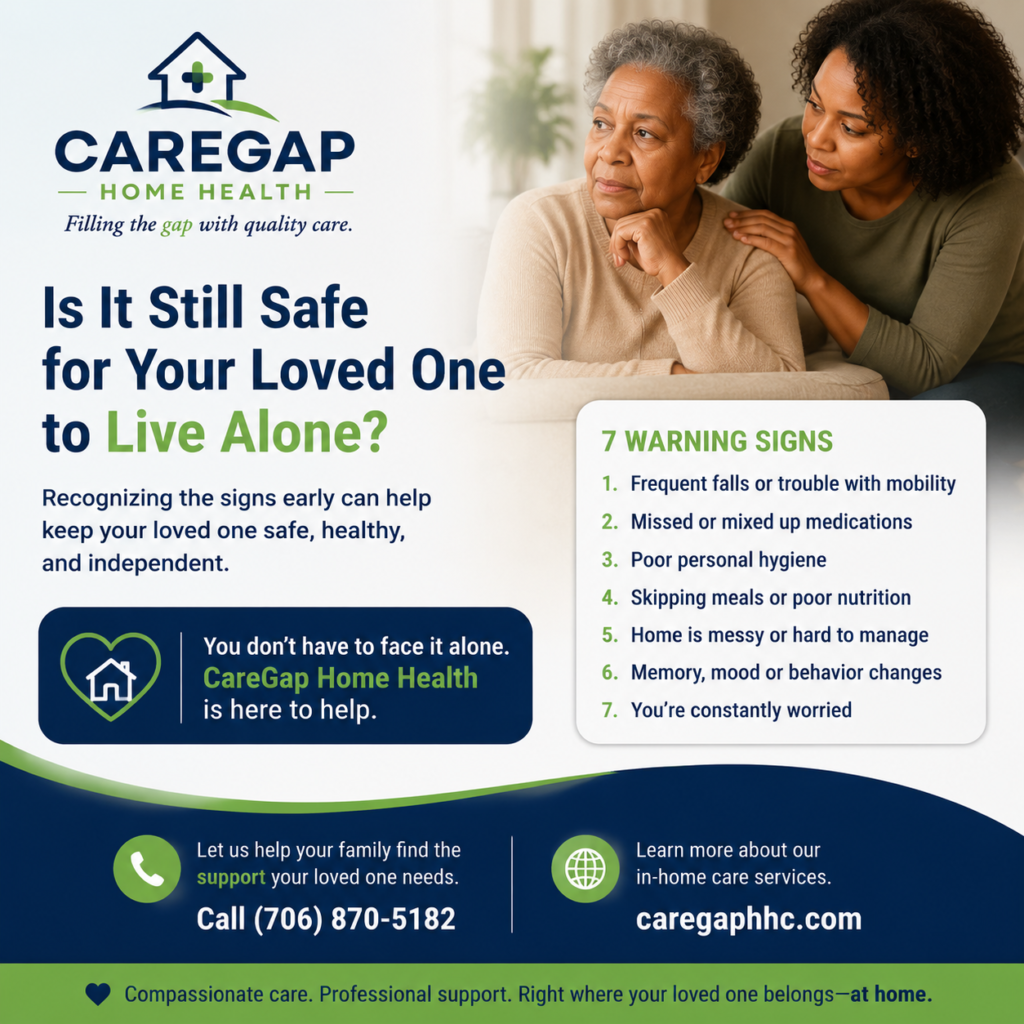
When Is It No Longer Safe for an Aging Parent to Live Alone?
For many older adults, remaining at home represents independence, comfort, and familiarity. For their families, however, there may come a time when a difficult question begins to surface:
Is Mom or Dad still safe living alone?
The answer is not always obvious. Changes can happen gradually, and an older adult may appear independent while quietly struggling with medications, meals, mobility, personal care, or everyday household tasks.
Recognizing these changes early can help families find the right level of support while helping their loved one remain as safe and independent as possible.
Here are seven warning signs families should watch for.
1. Frequent Falls or Problems With Mobility
A fall can have serious consequences for an older adult.
Pay attention if your loved one has started holding onto furniture while walking, struggling with stairs, having difficulty getting out of a chair, or experiencing falls or near-falls.
Even if no serious injury has occurred, changes in balance or mobility deserve attention.
Simple modifications such as improving lighting, clearing walkways, securing rugs, and installing appropriate safety equipment may help. Some individuals may also need additional assistance with daily activities.
2. Medications Are Being Missed or Mixed Up
Managing several medications can become complicated.
You may notice:
- Missed doses
- Medication being taken at the wrong time
- Confusion between prescriptions
- Empty prescriptions that have not been refilled
- Difficulty remembering medication instructions
Medication concerns are especially important after hospitalization or when prescriptions have recently changed.
Families should discuss medication concerns with the appropriate healthcare professional rather than changing or stopping prescribed medication independently.
3. Personal Hygiene Has Changed
Changes in appearance or hygiene can sometimes indicate that everyday activities are becoming more difficult.
Perhaps your parent is bathing less frequently, wearing the same clothes repeatedly, struggling with grooming, or having difficulty getting dressed.
Rather than assuming they simply “don’t care anymore,” ask whether something is making these activities difficult.
Pain, weakness, mobility problems, memory changes, or fear of falling in the bathroom can all make personal care more challenging.
4. The Kitchen Tells a Different Story
Take a look around the kitchen when you visit.
Is there spoiled food in the refrigerator?
Are meals being skipped?
Has your loved one lost noticeable weight?
Are they relying almost entirely on snacks because preparing meals has become difficult?
Changes in eating habits can be an important signal that additional support may be needed.
Sometimes an older adult still has a healthy appetite but no longer has the energy, strength, or confidence to shop and prepare meals safely.
5. The Home Is Becoming Difficult to Manage
A home that was once well maintained may gradually become cluttered or neglected.
Unopened mail may accumulate. Laundry may remain unfinished. Dishes may pile up. Trash may not be taken out.
One untidy room does not necessarily indicate a problem.
The important thing is to notice changes from your loved one’s normal routine.
A significant decline in household management can indicate that everyday responsibilities are becoming overwhelming.
6. There Are Changes in Memory, Mood, or Behavior
Occasional forgetfulness can happen to anyone, but significant or sudden changes deserve attention.
You might notice your loved one:
- Repeating the same questions frequently
- Missing important appointments
- Becoming unusually confused
- Withdrawing from friends and activities
- Showing noticeable personality changes
- Forgetting familiar routines
Sudden confusion or significant behavioral changes should be discussed promptly with an appropriate healthcare professional, as they may have causes that require medical attention.
7. You Are Constantly Worried About Leaving Them Alone
Sometimes the strongest warning sign is how much the family has already changed its life to keep things functioning.
Are you calling several times a day?
Are you constantly checking whether medications were taken?
Are you leaving work to handle emergencies?
Are you afraid something will happen overnight?
Are siblings repeatedly rearranging their schedules because someone needs to check on Mom or Dad?
If caring for your loved one has quietly become a full-time responsibility, it may be time to explore additional support.
Does Needing Help Mean They Must Leave Home?
Not necessarily.
Recognizing that someone needs assistance does not automatically mean they must move into a facility.
For some families, appropriate in-home support can help an older adult continue living in familiar surroundings while receiving assistance based on their individual needs.
The important question is not simply:
“Can they live alone?”
A better question may be:
“What support would help them live at home more safely?”
That change in perspective can make conversations about care much easier for families.
Start the Conversation Early
Families often wait for a crisis before discussing care.
It may be a serious fall, hospitalization, medication mistake, or another emergency that finally forces everyone to act.
Whenever possible, begin the conversation earlier.
Approach your loved one with respect. Talk about maintaining independence rather than taking independence away.
Ask:
“What is becoming difficult for you?”
“What would make things easier at home?”
“What would help you feel safer?”
Listening to the answers can help the family determine the next step together.
CareGap Home Health Is Here to Help
If you are beginning to wonder whether an aging parent or loved one needs additional support at home, you don’t have to wait until there is a crisis to start asking questions.
CareGap Home Health helps families explore care options designed to support safety, comfort, dignity, and independence at home.
If you’re unsure what level of assistance your loved one may need, contact our team to discuss your family’s situation.
CareGap Home Health
Filling the gap with quality care.
📞 +1 (706) 870-5182
🌐 caregaphhc.com
Serving Braselton, Georgia and surrounding communities.