
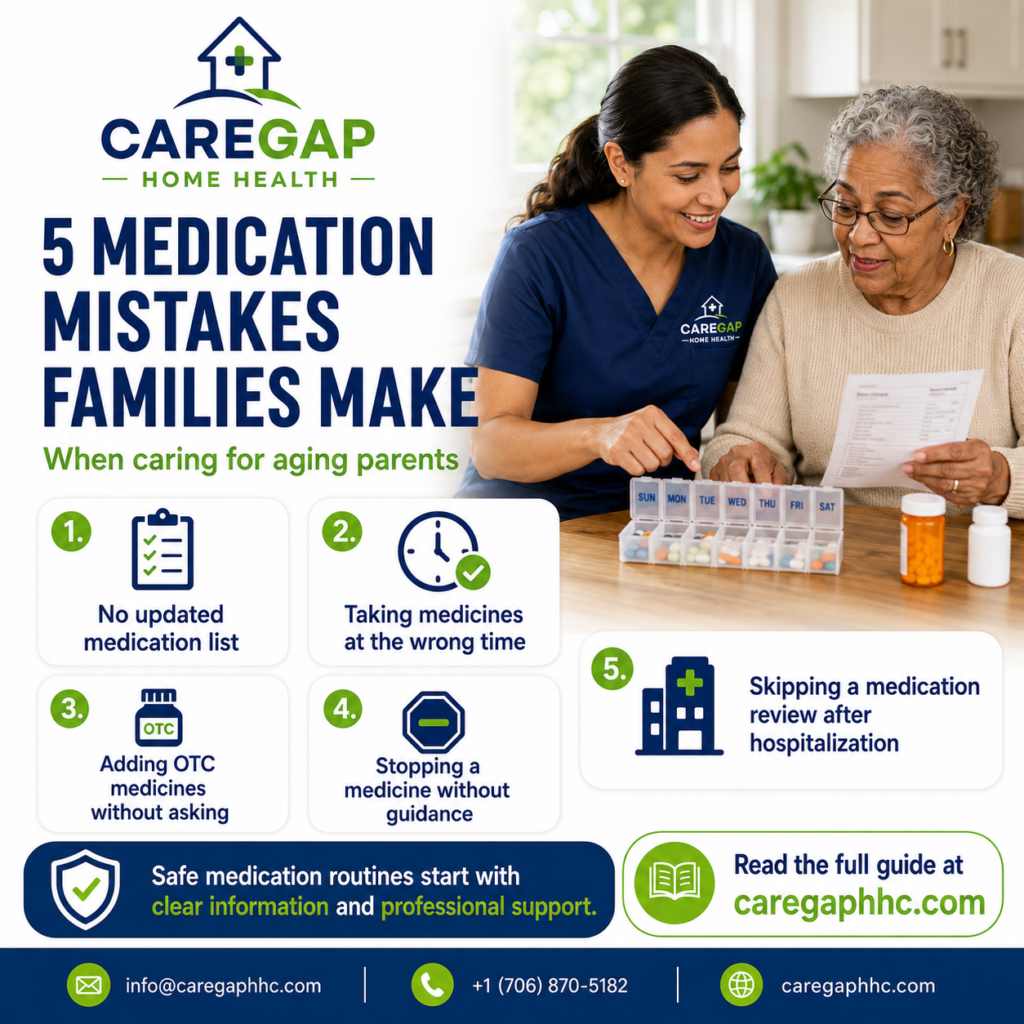
Medication routines can become more complicated as people age. Many older adults take several prescriptions, over-the-counter medicines, vitamins, or supplements. When medications are not organized or taken as directed, mistakes can occur.
The good news is that many medication-related problems can be reduced with clear communication, a consistent routine, and support from healthcare professionals. The FDA and National Institute on Aging recommend keeping an up-to-date medication list and reviewing all medicines regularly with a doctor or pharmacist.
Here are five common medication mistakes families should watch for when caring for an aging parent.
1. Not Keeping an Updated Medication List
One of the most common mistakes is relying on memory instead of keeping a written or digital list.
A complete medication list should include:
- The name of each prescription
- The dosage
- How often it is taken
- The time it should be taken
- Over-the-counter medicines
- Vitamins and supplements
- Allergies or previous reactions
The list should be updated whenever a medication is started, stopped, or changed. Keep a copy at home and bring it to medical appointments or emergency visits.
An accurate list helps doctors, nurses, and pharmacists identify possible duplicate medicines, interactions, or dosing problems.
2. Taking Medicines at the Wrong Time
Some medicines need to be taken at specific times of day or with food. Others may need to be taken on an empty stomach or separated from another medicine.
Missing doses, taking doses too close together, or taking a medicine at the wrong time can affect how well it works.
Helpful strategies include:
- Using a pill organizer
- Setting phone alarms
- Keeping a written schedule
- Connecting medication times to regular routines
- Asking a pharmacist to explain food or timing instructions
The CDC recommends following the prescription instructions or label directions and using reminders when needed.
3. Adding Over-the-Counter Medicines Without Asking
Many families focus on prescriptions but forget to mention over-the-counter medicines, herbal products, and supplements.
A product that seems harmless may interact with a prescription medicine or worsen an existing health condition. Some medicines can also cause dizziness, drowsiness, confusion, or an increased risk of falling in older adults.
Before adding a new pain reliever, sleep aid, cold medicine, vitamin, or supplement, speak with a doctor or pharmacist.
Always provide the complete medication list—not only prescription medications—during appointments.
4. Stopping a Medicine Without Professional Guidance
Some people stop taking a medicine because they feel better, experience a side effect, or believe the medicine is no longer necessary.
However, suddenly stopping certain medications can create health risks. Other medicines may need to be reduced gradually under professional supervision.
If your loved one wants to stop or change a medication, contact the prescribing healthcare provider or pharmacist first. Do not change the dosage or schedule without professional guidance.
A healthcare professional can help determine whether the medicine should be continued, adjusted, replaced, or safely reduced.
5. Failing to Review Medications After a Hospital Stay
Medication mistakes are especially common during transitions between the hospital, rehabilitation, and home.
A prescription may be added in the hospital while another medicine is discontinued. Sometimes families receive several instructions and are unsure which medication list is current.
After a hospital or rehabilitation stay:
- Compare the discharge medication list with the medicines already at home.
- Ask which medications were started, stopped, or changed.
- Confirm the correct dosage and schedule.
- Remove or separate discontinued medicines.
- Share the updated list with the primary-care provider and pharmacist.
A medication review can help reduce confusion and support a safer transition home.
How Caregivers Can Support Medication Safety
Caregivers may help by:
- Providing medication reminders
- Keeping medicines organized
- Observing whether doses are being missed
- Reporting concerning symptoms
- Maintaining an updated medication list
- Communicating changes to the family
- Preparing questions for the doctor or pharmacist
Caregivers should not diagnose side effects, change dosages, or give medical advice outside their training. Any concern about a medication should be directed to the appropriate healthcare professional.
CareGap’s Pharmacist-Led Approach to Home Care
At CareGap Home Health, we understand that medication routines can be challenging for older adults and their families.
Our pharmacist-led approach helps keep medication awareness, communication, consistency, and safety at the center of every care plan. Depending on the client’s needs, our services may include personal care, companion care, medication reminders, skilled nursing, health monitoring, and post-hospital transition support.
Our goal is to help families feel informed and supported while their loved ones remain safe and comfortable at home.
When Should Your Family Ask for Help?
Consider speaking with a home-care professional if your loved one:
- Frequently forgets medications
- Confuses one medicine with another
- Has difficulty opening containers
- Has trouble reading labels
- Experiences repeated dizziness or confusion
- Has recently returned home from the hospital
- Takes several prescriptions and supplements
- Lives alone or has limited family support
Early support may help prevent avoidable mistakes and reduce stress for everyone involved.
Talk With CareGap Home Health
If your family needs support with personal care, companionship, medication reminders, skilled nursing, or recovery after hospitalization, CareGap Home Health is here to help.
We serve Braselton, Georgia, and surrounding areas with safe, reliable, thoughtful home care.
CareGap Home Health
2164 Northern Oak Drive
Braselton, GA 30517
Phone: (706) 870-5182
Email: info@caregaphhc.com
Website: www.caregaphhc.com
Filling the GAP with Quality Care.