For many Veterans, home represents more than four walls.
It is independence. Familiarity. Family. Memories. Dignity.
But as everyday activities such as bathing, dressing, preparing meals, moving safely around the home, or keeping up with personal care become more difficult, families are often faced with a painful question:
How can we give our loved one the help they need without taking away the home and independence they value?
For some Veterans and surviving spouses, an important VA benefit may help answer that question.
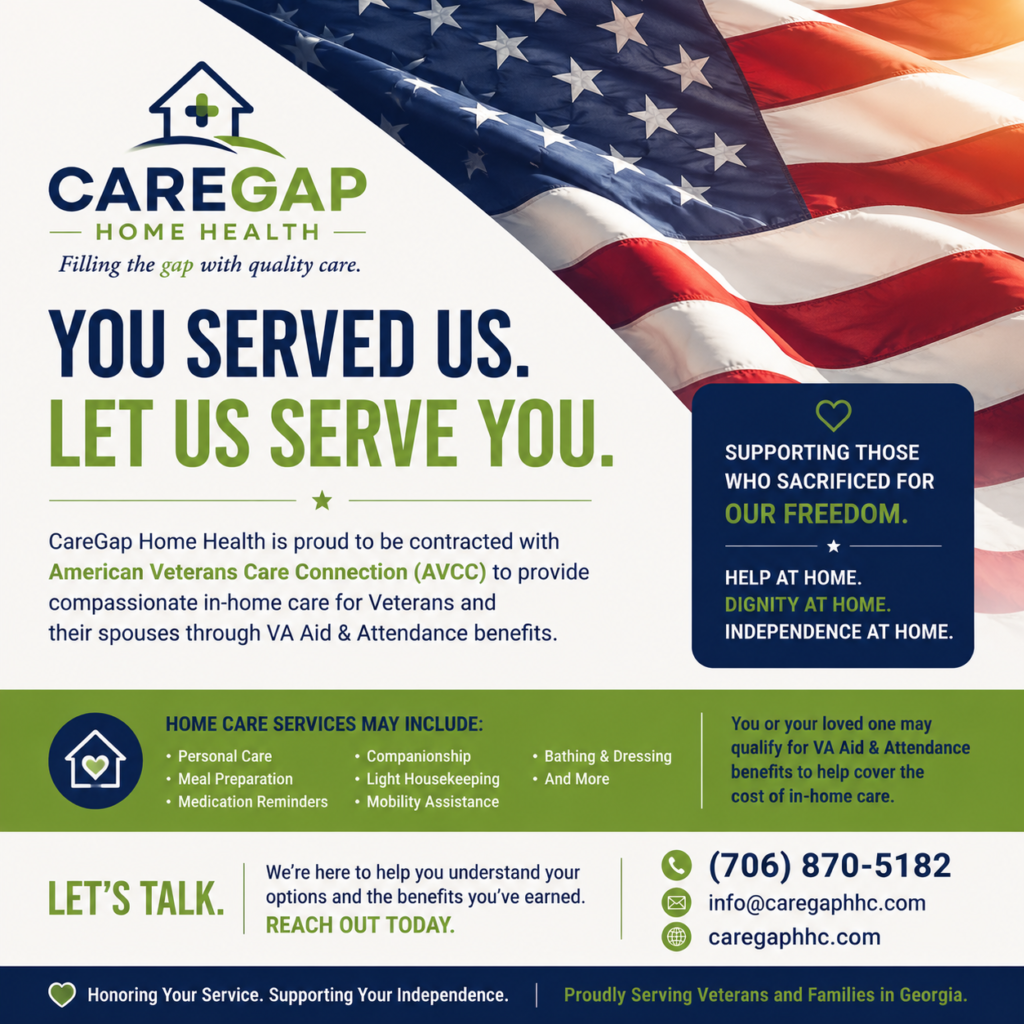
CareGap Home Health is proud to announce that we are now contracted with American Veterans Care Connection (AVCC), expanding our ability to support eligible Veterans and surviving spouses who need quality care in the comfort of home.
And if you have never heard of AVCC or VA Aid and Attendance before, you are not alone.
What Is AVCC?
American Veterans Care Connection (AVCC) helps Veterans and surviving spouses understand and pursue the VA Aid and Attendance pension benefit and connects eligible families with home care providers.
AVCC says it was created after recognizing that many Veterans were unaware of Aid and Attendance or did not know that qualifying benefits could help with the cost of home care. (AVCC Home Care)
That makes AVCC an important bridge between three things:
Veterans who need help → benefits they may qualify for → quality care delivered at home.
And now, CareGap is proud to be part of that care connection.
What Is VA Aid and Attendance?
Aid and Attendance is not simply another insurance plan.
The U.S. Department of Veterans Affairs describes Aid and Attendance as an additional monthly payment for qualified Veterans and survivors who already receive a VA pension and meet certain care-related requirements. (Veterans Affairs)
For someone who qualifies, these additional pension funds may help offset eligible care expenses, including home care. AVCC specifically works with Veterans and surviving spouses to understand how Aid and Attendance may be used toward the cost of home care services. (AVCC Home Care)
This matters because many families are already providing hours of unpaid support without realizing that another option may exist.
Could You or Your Loved One Potentially Qualify?
Eligibility is individual, and no home care agency should promise that someone will qualify before their circumstances are reviewed.
According to the VA, a person receiving a VA pension may potentially qualify for Aid and Attendance if at least one qualifying condition applies, including needing another person to help with daily activities such as bathing, feeding, or dressing; spending much of the day in bed because of illness; residing in a nursing home because of loss of physical or mental abilities; or meeting specific vision-loss criteria. (Veterans Affairs)
Surviving spouses may also qualify for VA Survivors Pension under specific service, income, net-worth and other eligibility requirements, and qualifying survivors who need assistance with daily activities may potentially receive Aid and Attendance in addition to their pension. (Veterans Affairs)
The important message is simple:
Do not assume that you are not eligible because nobody has previously told you about the benefit.
Ask.
What Can Home Care Actually Help With?
Home care is not about taking control away from a Veteran.
Done properly, it can help preserve independence.
Depending on the person’s assessed needs and the services arranged, support at home may include help with everyday activities such as:
- Bathing and personal hygiene
- Dressing and grooming
- Meal preparation
- Eating
- Mobility and transfers
- Light housekeeping
- Laundry
- Grocery shopping
- Companionship
- Maintaining a safer daily routine
The VA itself recognizes home-based assistance with activities such as eating, dressing, grooming, bathing, toileting, transferring and grocery shopping as ways home care can help Veterans remain in their own homes. (Veterans Affairs)
AVCC likewise describes home care as support that can help Veterans and surviving spouses maintain quality of life while remaining at home. (AVCC Home Care)
The Benefit Is Not Only for the Veteran
There is another person we should talk about:
the spouse, daughter, son or relative who has quietly become the caregiver.
Family caregiving can begin with small things.
A ride to an appointment.
Preparing dinner.
Helping with medications.
Checking in before bed.
Then, gradually, it can become bathing, dressing, lifting, cooking, cleaning, shopping, supervision and being available around the clock.
The VA specifically recognizes caregiver burden as one reason Veterans may need home and community-based support. (Veterans Affairs)
Professional care does not replace the family.
It can give the family room to become family again.
A spouse can spend more time being a spouse.
A daughter can visit as a daughter.
A son can sit down and have a conversation with Dad without every visit becoming another list of caregiving tasks.
That difference matters.
“But I Can Still Do Most Things Myself.”
Good.
Home care does not have to mean giving up independence.
In fact, the objective may be exactly the opposite.
Someone may only need assistance with the areas that have become difficult while continuing to do everything else they are able to do safely.
The VA notes that home health aide assistance can be provided according to assessed need—sometimes several times per week and sometimes less frequently. (Veterans Affairs)
Care should fit the person.
The person should not have to fit the care.
Why Families Often Miss This Opportunity
One of the biggest barriers isn’t always eligibility.
Sometimes it is simply awareness.
AVCC says that part of the reason it exists is because many Veterans do not know about Aid and Attendance or understand how it can relate to receiving care at home. (AVCC Home Care)
Other families may have heard the words “VA benefits” and immediately assumed:
- “We probably don’t qualify.”
- “The process will be too complicated.”
- “That is only for disabled Veterans.”
- “We can manage on our own.”
- “Nobody ever told us about this.”
That is exactly why having the conversation matters.
You do not need to understand every form, eligibility rule or benefit before asking for help.
What Happens If You Contact CareGap?
We want the first step to feel simple.
If you are a Veteran, surviving spouse, or family member caring for someone who may need assistance at home, contact CareGap and tell us that you are interested in Veteran home care through AVCC.
Our team can talk with you about the type of support your loved one needs and help connect you with the appropriate AVCC process for determining potential Aid and Attendance eligibility.
AVCC provides eligibility screening and assistance around the Aid and Attendance process and connects Veterans and surviving spouses with home care providers. (AVCC Home Care)
There is no need to diagnose your own eligibility before making the call.
Start with the conversation.
A Message to Our Veterans and Their Families
You spent years showing up when your country needed you.
Accepting help now does not erase your independence.
It can help protect it.
If getting dressed has become difficult, if preparing meals is exhausting, if your spouse is carrying more of the caregiving burden every month, or if staying safely at home is becoming harder, there may be options you have not explored yet.
And you deserve to know what those options are.
CareGap Home Health + AVCC
CareGap Home Health is proud to expand our support for Veterans and their families through our new relationship with American Veterans Care Connection.
Our goal is not simply to provide a caregiver.
It is to help families create a home environment where their loved one can continue experiencing dignity, safety, companionship, comfort and as much independence as possible.
Do You Know a Veteran or Surviving Spouse Who Needs Help at Home?
Please don’t keep this information to yourself.
Share this article with a Veteran, military family, church member, neighbor, friend or relative who may benefit from learning about home care and Aid and Attendance.
One conversation could introduce a family to support they did not know was available.
Talk to CareGap Home Health
Have questions about Veteran home care or AVCC?
Contact CareGap Home Health and let us help you understand the next step.
CareGap Home Health
Filling the gap with quality care.
📞 (706) 870-5182
📧 info@caregaphhc.com
🌐 caregaphhc.com
Serving Veterans, seniors and families across our Georgia service communities.
Eligibility for VA benefits is determined under applicable Department of Veterans Affairs requirements. CareGap Home Health does not determine or guarantee VA benefit eligibility.