What Is GAPP? A Guide for Georgia Families Seeking In-Home Pediatric Care
Caring for a child with complex medical needs can be rewarding, but it can also place significant demands on families. Between medications, appointments, personal care, feeding needs and other daily responsibilities, parents may find themselves wondering whether additional professional support is available at home.
For eligible Georgia families, the Georgia Pediatric Program (GAPP) may provide that support.
What Is GAPP?
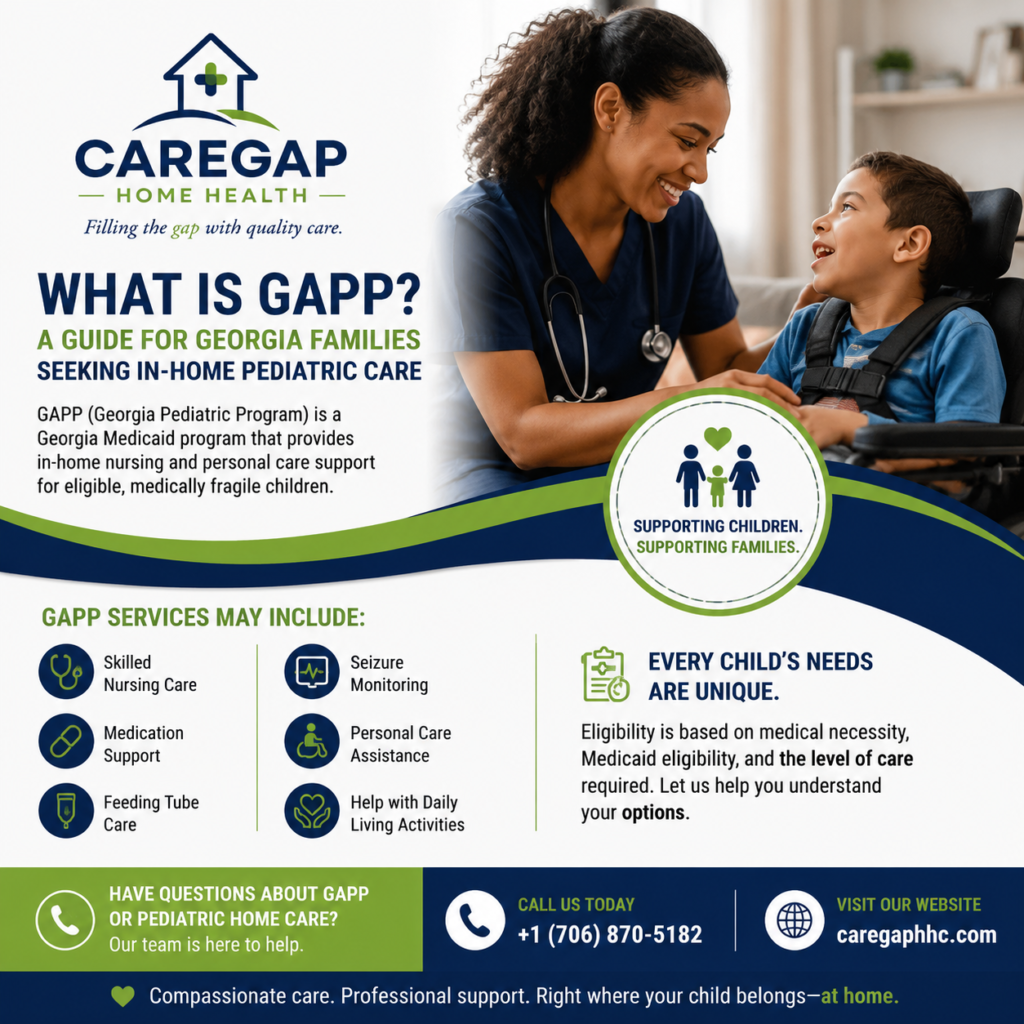
The Georgia Pediatric Program, commonly called GAPP, is a Georgia Medicaid program that provides in-home nursing and personal care support services to eligible medically fragile children.
Georgia Medicaid explains that the program serves medically fragile children with significant medical needs and provides services in the child’s home and community. These services may include skilled nursing and personal care assistance with activities of daily living. (Georgia Medicaid)
The goal is to help eligible children receive medically necessary care while remaining in a familiar home environment with their families.
What Services Can GAPP Provide?
The exact services a child receives depend on their individual medical needs and approved plan of care.
Depending on eligibility and medical necessity, GAPP services may include:
- Skilled nursing care
- Medication-related support
- Assistance with feeding needs
- Monitoring of complex medical conditions
- Personal care assistance
- Help with activities of daily living
- Support for children requiring ongoing medical supervision
GAPP providers may employ registered nurses, licensed practical nurses and personal care professionals to deliver approved services in the home. (GeorgiaGAPP.com)
Who May Qualify for GAPP?
GAPP is not based simply on a child’s diagnosis.
Eligibility is determined by factors including the child’s medical condition, the level of care required, Medicaid eligibility and whether the requested services are considered medically necessary.
A physician’s involvement and medical documentation are also important parts of establishing the need for care.
Georgia Medicaid advises families seeking GAPP services to contact a participating GAPP provider agency directly to begin the process. (Georgia Medicaid)
Can a Child With Autism Receive GAPP Services?
Parents of children with autism often ask this question.
An autism diagnosis by itself does not automatically mean that a child qualifies for GAPP.
However, some children with autism may also have significant medical or personal-care needs. In those situations, eligibility would be considered based on the child’s individual medical necessity and level of required support rather than the autism diagnosis alone.
Every child’s situation is different, which is why families should speak with an approved provider about their child’s specific needs.
What About Children With Complex Medical Needs?
GAPP can be particularly important for families caring for medically fragile children who require substantial support at home.
Examples may include children who require assistance related to:
- Feeding tubes
- Tracheostomy or ventilator care
- Seizure monitoring
- Complex medication routines
- Mobility limitations
- Significant personal-care needs
- Other conditions requiring skilled nursing supervision
These examples do not guarantee eligibility. The level of care must still be medically necessary and approved for the individual child.
Why In-Home Pediatric Care Matters
For families caring for medically fragile children, home is more than a place to live. It is where children spend time with parents and siblings, build routines and experience everyday family life.
Having appropriate professional support at home may also help parents feel more confident managing their child’s needs while allowing the child to receive approved care in a familiar environment.
The purpose is not to replace the parent.
It is to help create a care team around the child.
Parents, caregivers, nurses and physicians can work together to support the child’s health, safety and quality of life.
How Do Families Start the GAPP Process?
A good first step is to speak with a GAPP provider agency.
Families should be prepared to discuss:
- The child’s medical diagnosis and current condition
- Medicaid status
- Current medications and treatments
- The level of assistance the child needs each day
- Existing physician recommendations
- Any skilled nursing or personal-care needs
The provider can then explain what documentation may be required and help the family understand the next steps.
Georgia Medicaid specifically directs families interested in GAPP services to contact a GAPP provider agency. (Georgia Medicaid)
You Don’t Have to Figure It Out Alone
Learning about Medicaid programs and pediatric home care can feel overwhelming, especially when you’re already focused on caring for your child.
The important thing to remember is that asking questions is a good place to start.
If your child has significant medical or personal-care needs and you are unsure whether GAPP may be an option, CareGap Home Health can help you understand the process and discuss your child’s individual situation.
New to Georgia? Start Here
Relocating makes an already complicated system harder. Georgia Medicaid does not transfer from another state — your child has to be enrolled here before a GAPP application can move forward, and that step alone commonly takes 30 to 45 days. If your family has recently moved to Georgia and your child has ongoing medical needs, start the Medicaid enrollment now rather than waiting until you have chosen an agency. CareGap Home Health can walk you through the order the steps need to happen in.
Common Questions From Parents
Is GAPP only for children?
Yes. GAPP serves eligible children and young adults under 21. Coverage ends at 21, so families of older teens should ask about adult waiver options well before that birthday.
What if my child does not have Georgia Medicaid yet?
Ask about the Katie Beckett (Deeming) Waiver. It can qualify a child with significant medical needs for Medicaid regardless of parental income — a common reason families wrongly assume they earn too much to apply.
Can CareGap help with the application itself?
Yes. As a GAPP-enrolled provider, we prepare and submit the application packet to Georgia Medicaid and follow up until there is an answer. Incomplete packets are the most common cause of delay, so this is not a small part of the process. See our full GAPP program page for how enrollment works step by step.
Hablamos Español.
Talk to CareGap Home Health
CareGap Home Health is committed to helping Georgia families understand their in-home care options and access compassionate, professional support when eligible.
Have questions about GAPP or pediatric home care?
Contact CareGap Home Health to speak with our team and learn more about the next steps for your family.
CareGap Home Health
Filling the gap with quality care.
📞 +1 (706) 870-5182
🌐 caregaphhc.com